

In a Q3 2026 survey, 54.9% of Canadian retail businesses expected domestic supply chain problems to continue for a year or more, according to Bridging Local. For retailers, delays can quickly disrupt product availability and replenishment plans. Reliable freight shipping for retail industry Canada operations depends on coordinating each shipment with inventory needs, delivery windows and cargo requirements, not simply moving goods from one point to another.
Retail freight needs can vary from routine replenishment to shipments with specific handling or timing requirements. Domestic routes and cross-border movements can add coordination needs, making clear communication and shipment visibility valuable parts of the plan. These realities are familiar to retailers balancing continuity with changing demand.
This guide explains how to assess freight requirements, compare service approaches and plan shipments across Canada with greater confidence. You’ll learn what to consider when matching shipment volume, timing and handling needs to inventory priorities, and how coordinated freight forwarding can reduce avoidable hand-offs. It also outlines practical questions that help bring shipment movement into clearer alignment with retail delivery commitments.
Key Takeaways
- Connect freight decisions to inventory availability and delivery commitments, while distinguishing freight movement from parcel fulfilment.
- Organize cargo details, dimensions, handling needs, route and timing before planning shipment movement.
- Compare dedicated, partial-load and other freight approaches against shipment volume, frequency, handling requirements and delivery windows.
- Use demand patterns and Just-in-Time systems to shape a practical freight plan and communication approach. This guide to freight shipping for retail industry Canada explains what to assess.
- Learn how Dubo International Logistics coordinates freight across Canada and North America at www.dubointl.com.
Why retail freight shipping in Canada depends on inventory commitments
Retail freight is part of keeping products available when and where the business needs them. Retail freight reliability is the coordinated movement of goods in line with inventory commitments and planned delivery windows. That’s the practical foundation of freight shipping for retail industry Canada operations: shipment choices should reflect what stock is needed, where it must go and when it needs to arrive.
Freight planning also differs from parcel fulfilment. Parcel services can suit individual customer orders, while freight approaches may be more appropriate for larger, consolidated or shipment-specific cargo. Neither is right for every movement. A retailer may need different arrangements for inbound merchandise, replenishment between business locations and outbound orders, based on shipment size, timing and handling needs. These decisions form part of supply chain management, connecting product movement with operational priorities.
Across Canada, longer routes and varied shipment profiles make it useful to define the inventory requirement before deciding how cargo should move. A dependable plan starts with the retail commitment, then accounts for the shipment that must support it.
Which retail shipment flows need freight planning?
Consider three common flows: merchandise moving from a supplier into the retail network, stock transferred between business locations, and customer orders that are suited to freight rather than parcel delivery. A recurring shipment of standard cartons has different requirements from a less frequent load of fragile or temperature-sensitive products. Record the shipment’s size, frequency, handling needs and destination so the plan reflects the actual cargo, not a general assumption about retail freight.
How do delivery commitments shape freight requirements?
A delivery window affects when stock can be made available for sale or used to replenish another location. Recurring shipments can be planned around established inventory patterns, while seasonal demand or an unexpected surge may call for separate coordination. Set the required delivery window and the consequence of a late arrival before comparing service approaches. Clear priorities help the freight plan support replenishment without treating every shipment as equally urgent.
Retail teams can start by identifying which products need replenishment, the locations receiving them, and the dates tied to inventory or customer commitments. Then consider whether the shipment is regular, variable or exceptional, and note any cargo-specific handling requirements. This turns delivery expectations into usable planning information and gives logistics partners a clearer basis for coordinating movement.
Dubo International Logistics coordinates freight forwarding across Canada and North America, aligning carrier coordination and shipment tracking with shipment-specific requirements. For support planning retail freight movement, visit www.dubointl.com.
How retail freight moves from shipment requirements to coordinated delivery
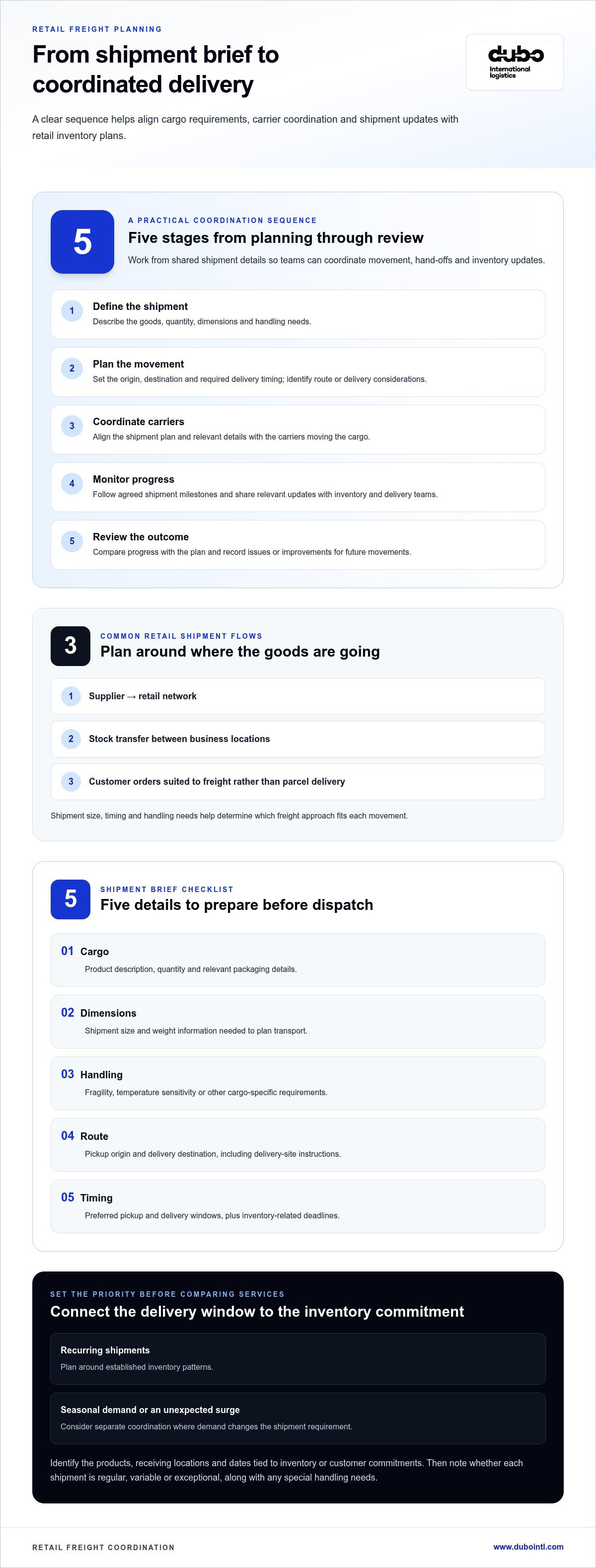
A retail shipment is easier to oversee when each party works from the same set of details. Before dispatch, teams should define the cargo and its requirements, plan the movement, coordinate carriers, follow progress and review the result. This sequence gives retailers a practical structure for managing freight shipping for retail industry Canada, from initial planning through delivery.
Clear shipment information before dispatch gives logistics partners a sound basis for coordinating the right movement, communicating hand-offs and keeping inventory plans informed.
- Define the shipment. Describe the goods, quantity, dimensions and handling needs.
- Plan the movement. Set the origin, destination and required delivery timing, then identify any route or delivery considerations.
- Coordinate carriers. Align the shipment plan and relevant details with the carriers involved in moving the cargo.
- Monitor progress. Follow agreed shipment milestones and share relevant updates with the teams responsible for inventory and delivery.
- Review the outcome. Compare the shipment’s progress with the plan and record issues or improvements for future movements.
What shipment details help shape a retail freight plan?
Prepare the shipment information as a working brief, and raise special handling needs during planning. Accurate details help inform carrier coordination and reduce uncertainty about what the movement requires.
- Cargo: Product description, quantity and any relevant packaging details.
- Dimensions: Shipment size and weight information needed to plan transport.
- Handling: Fragility, temperature sensitivity or other cargo-specific requirements.
- Route: Pickup origin and delivery destination, including any delivery-site instructions.
- Timing: Preferred pickup and delivery windows, plus any inventory-related deadlines.
For example, a shipment of delicate merchandise may need handling instructions that differ from those for standard cartons. Record those requirements alongside the cargo description rather than relying on informal messages that may not reach everyone coordinating the movement.
How can retailers follow freight progress and hand-offs?
Choose useful milestones for the shipment, such as dispatch, a carrier hand-off, progress toward the destination and delivery. The exact updates available can vary by movement, so define how information will be shared and who is responsible for passing it to the retail team. Tracking systems can help provide shipment oversight without replacing clear communication between those managing the freight and those planning stock.
When an update indicates a change, the inventory team can assess whether replenishment plans or internal expectations need to be adjusted. This matters in a Canadian supply chain where coordinated movement is one part of broader planning; Canadian Supply Chain Challenges in 2026 provides related industry context.
Dubo International Logistics coordinates freight forwarding across Canada and North America, with carrier coordination and tracking systems supporting specialized transportation deliveries. Retailers developing shipment processes can explore Dubo’s logistics support at www.dubointl.com.
How to compare retail freight shipping options without a one-size-fits-all choice
The right freight approach depends on the shipment, not just the product category. Retailers comparing freight shipping for retail industry Canada should weigh volume, frequency, handling needs, delivery windows and route together. A recurring shipment of standard cartons may call for a different plan than a time-sensitive load or delicate products that need particular care.
Use the comparison below to identify which questions matter before settling on an approach. These are planning considerations, not fixed service guarantees; the best fit depends on the shipment profile and inventory priorities.
| Approach | Potential fit | Coordination and planning considerations |
|---|---|---|
| Dedicated transport | A shipment with specific timing, handling or movement requirements | Define the delivery window, cargo needs and route priorities; coordinate the movement around those requirements. |
| LTL freight shipping | A shipment that can share trailer capacity with other shippers | Assess dimensions, handling, delivery timing and how shared movement fits the inventory plan. |
| Other freight approaches | A shipment profile that does not align with the options above | Compare frequency, route, cargo characteristics and delivery expectations to determine the planning requirements. |
When might LTL freight shipping fit retail shipments?
LTL freight shipping is less-than-truckload transport in which multiple shippers share trailer capacity. It can suit some retail shipments when the load’s dimensions and handling requirements work within a shared-capacity movement. Consider whether the delivery window can accommodate the planned coordination and whether the goods have needs that call for specific handling. LTL isn’t automatically the right fit for every shipment, so assess it against the cargo and replenishment plan.
When should retailers consider specialized transportation?
Cargo characteristics can shape the transport plan. Out-of-gauge machinery, fragile equipment and temperature-sensitive products may call for tailored coordination and carriers with capabilities suited to the shipment. Retailers should make these requirements clear early, including relevant dimensions, handling instructions and timing, so the movement can be planned around the cargo rather than treated as routine freight. Dubo’s specialized freight buyer’s guide offers related guidance for assessing specialized shipment needs.
For a useful comparison, write down the shipment’s must-haves first: delivery window, handling, volume, recurrence and route. Then consider how each approach supports those priorities and what coordination it entails. A recurring load with predictable requirements may be planned differently from a one-time surge or an unusually sensitive shipment. This keeps the decision grounded in inventory and delivery commitments instead of a blanket preference for one service type.
Dubo International Logistics coordinates freight forwarding across Canada and North America, including specialized transportation for complex freight requirements. Retailers can explore freight coordination support at www.dubointl.com.
How Canadian retailers can prepare freight plans for demand changes
Demand can shift faster than a freight plan built around an average week. Proactive planning connects expected volume changes with shipment timing, cargo requirements and inventory priorities, giving teams a clearer basis for adapting as conditions change. Proactive freight planning supports continuity by helping retail teams respond to demand changes with coordinated shipment decisions.
This matters especially for retailers using Just-in-Time systems, where goods are scheduled to arrive close to when they’re needed. A change in sales or supply timing can affect replenishment plans, so freight assumptions should be reviewed alongside inventory expectations. For freight shipping for retail industry Canada, the aim is to prepare for variation without assuming that every shipment can follow the same schedule.
How should retail teams prepare for seasonal volume changes?
Map anticipated demand changes against known shipment and delivery commitments. A seasonal promotion, for example, may increase the volume of familiar products, while a product launch may introduce new handling needs. Share revised expectations early with the team coordinating freight. Advance communication supports planning, but it doesn’t guarantee capacity or a particular delivery outcome.
Use a working checklist to keep the plan current:
- Shipment patterns: Note recurring movements, expected peaks and likely volume changes.
- Delivery windows: Record dates tied to replenishment, promotions or other business commitments.
- Cargo needs: Flag changes in dimensions, packaging, fragility or other handling requirements.
- Communication: Identify who shares updates and which teams need to receive them.
- Contingencies: Consider how a changed pickup or delivery window would affect inventory plans, and identify what information would prompt a review.
Review the checklist as forecasts change. If a shipment’s timing shifts or its cargo requirements differ from the original plan, update the relevant teams and reassess the movement rather than relying on outdated assumptions.
What should retail teams align across departments?
Purchasing, inventory and logistics teams each hold information that can shape a freight plan. Purchasing may know when supplier orders are changing; inventory teams can identify replenishment priorities; logistics staff coordinate the shipment details and movement. Agree on who owns updates and how changes are communicated, so decisions reflect a shared picture rather than separate departmental records.
ERP, enterprise software used to integrate operational and business data, can help teams align shipment information with purchasing and inventory plans. Shared, current records can reduce avoidable gaps, such as a revised delivery window not reaching the team responsible for replenishment. They don’t replace clear ownership: teams still need consistent processes for updating information and acting on it.
When a shipment has a time-sensitive requirement, Dubo Expedited may be a relevant option within the retailer’s freight planning. Dubo International Logistics coordinates freight forwarding across Canada and North America. Explore freight coordination support at www.dubointl.com.
How Dubo International Logistics supports retail freight coordination
Retail freight planning works best when shipment decisions connect to the way a business actually operates. Dubo International Logistics approaches freight forwarding as a coordination relationship, bringing the retailer’s requirements and logistics priorities into the planning discussion rather than treating each movement as an isolated transport booking.
That work can include clarifying responsibilities, aligning shipment information among the parties involved and considering how a freight process supports retail operations. Dubo’s logistics consulting can help retailers review recurring workflows, identify where information or decision-making needs clearer ownership, and consider how freight planning fits purchasing and inventory priorities.
What does a coordinated freight relationship look like?
The retailer shares its operational requirements, and Dubo uses them to guide the coordination plan. This includes establishing which shipment details matter to the movement, how relevant information should be communicated and how responsibilities are understood across the working relationship. A clear division of roles can help teams respond consistently when a shipment detail changes. Retailers seeking broader context can explore end-to-end freight management as a planning approach.
For example, a retailer with recurring movements may benefit from reviewing how shipment instructions are prepared and updated between orders. The aim is to make the process reflect the retailer’s operating priorities, with room to account for differences between routine and unusual shipments.
What should retailers bring to an initial logistics discussion?
Come prepared to describe the patterns and priorities behind the freight, not only an individual load. Useful discussion points include:
- Shipment patterns: Recurring movements, seasonal variation and known changes in demand.
- Cargo information: Product characteristics and any special handling considerations.
- Delivery expectations: Operational priorities that shape when goods are needed.
- Routes: Domestic movements and cross-border routes relevant to the business.
- Current processes: How teams share shipment information and manage changes.
This context helps focus the conversation on the retailer’s working needs and where logistics consulting or freight coordination may support them. It also gives the team a basis for discussing how requirements differ across routine and specialized shipments.
To discuss your retail freight requirements and explore a coordination approach suited to your operations, contact Dubo International Logistics.
Put your next retail freight plan into motion
Your next step is to turn freight priorities into a working plan your teams can revisit as demand shifts. Set out what must arrive, when it matters, and what cargo or route requirements could affect coordination. This gives purchasing, inventory and logistics teams a common starting point for planning freight shipping for retail industry Canada with greater clarity.
Dubo International Logistics brings a coordination-focused perspective, supported by CIFFA membership, nationwide Canadian coverage and North American logistics support. Its carrier network and tracking systems support specialized transportation deliveries, helping keep shipment oversight connected to operational planning.
Bring your shipment patterns, timing priorities and cargo requirements to a discussion with Dubo. Together, you can consider how freight forwarding and logistics consulting may support your retail movement requirements. Discuss your retail freight requirements at www.dubointl.com and take the next step toward a freight plan shaped around your business needs.
Frequently Asked Questions
Can a freight forwarder coordinate retail shipments across Canada and the United States?
Yes. A freight forwarder can serve as a coordination point for retail movements between Canada and the United States, helping align the parties involved around a shipment. For freight shipping for retail industry Canada, define who receives carrier updates, who shares changes internally and who handles questions about shipment information. The arrangement depends on the cargo, route and timing; coordination organizes the movement but doesn’t guarantee a fixed arrival result. Dubo’s services are at www.dubointl.com.
Is LTL freight shipping suitable for retail replenishment?
LTL may be suitable when a retailer’s operating plan can accommodate the approach’s handling and timing profile. Don’t judge fit by shipment size alone. Compare expected arrival timing with the product’s stock-cover threshold and the receiving team’s ability to process a delivery if plans change. Review previous shipment outcomes, where available, including handling exceptions, then weigh those observations against current inventory priorities. No single service approach fits every replenishment movement.
What information should a retailer provide when planning a freight shipment?
Give the logistics team a usable picture of the load and its movement, and add context that helps connect freight activity to retail operations. An internal order reference, if used, can help colleagues match shipment updates to purchasing records. Identify relevant pickup and receiving contacts, and flag whether the movement is linked to other consignments or a broader order. Share changes promptly so the team isn’t working from superseded information.
How can retail teams prepare freight plans for seasonal demand changes?
Prepare more than one demand scenario, such as the expected seasonal pattern, a stronger-than-expected response or a delayed supplier shipment. For each scenario, decide what signal would trigger a planning review and who can approve changes to the movement. This gives teams a decision framework before pressure builds. Keep assumptions visible and revisit them as sales or supply information changes, rather than treating an early forecast as a fixed instruction.
Can fragile retail goods require specialized transportation?
Yes. For fragile goods, describe which parts are vulnerable, any orientation or stacking restrictions, and handling cautions provided with the product. Clarify whether the existing packaging is intended to protect the item during transport, rather than assuming a general “fragile” label explains its needs. Item-specific information helps the logistics team understand the shipment’s sensitivities and consider an appropriate plan without assuming the same protective method suits every product.
Which shipment milestones should retail teams monitor?
Agree on which events require a decision, not just an update. For example, determine who can assess inventory implications if a shipment status changes and a planned arrival no longer aligns with the receiving team’s internal schedule. Use consistent status terms so purchasing, inventory and logistics teams interpret an exception the same way. Recording the decision and its reason can also help teams refine how they respond to similar changes in future.
